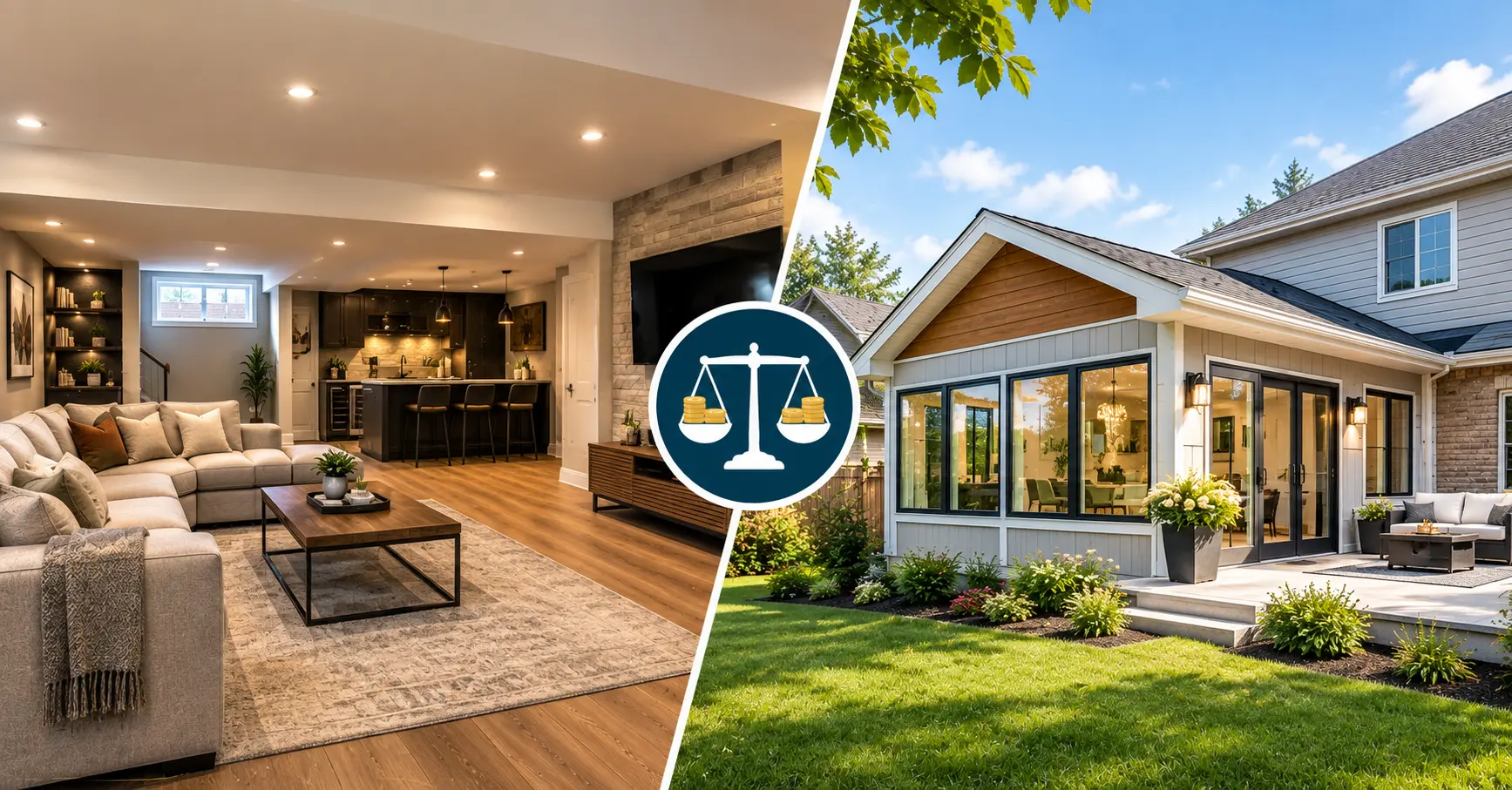
If your family has outgrown your current home, you’re likely facing one big question: finish the basement, or build an addition? Both options add usable living space without the cost and disruption of moving but the price difference between them is bigger than most Toronto homeowners expect.
This guide breaks down real 2026 GTA pricing for both options, what drives the cost up or down, and which one actually pays you back faster.
Table of Contents
- Basement Renovation Cost in Toronto (2026)
- Home Addition Cost in Toronto (2026)
- Basement Renovation vs. Home Addition: Cost Per Square Foot
- Which One Actually Pays You Back?
- So, Which Should You Choose?
- A Word on Hidden Costs
- FAQs
Basement Renovation Cost in Toronto (2026)
A basement renovation in Toronto typically costs $35 to $140+ per square foot, depending entirely on scope:
- Basic rec room (no plumbing, just framing, insulation, drywall, flooring): $30,000–$45,000
- Mid-range basement with a 3-piece bathroom: $44,000–$60,000 for an 800 sq. ft. space
- Legal basement suite (separate entrance, kitchen, bathroom, fire separation, egress window): $90,000–$150,000+
The single biggest cost driver isn’t finishing quality it’s how much moisture and structural work the space needs before finishing even begins. A dry, standard-height basement with no plumbing changes sits at the low end. A basement that needs underpinning for ceiling height, or a full legal-suite conversion, climbs fast.
Permits for a standard basement renovation run $1,000–$1,500 in the City of Toronto, and timelines are relatively short 4 to 6 weeks for a basic finish, longer if plumbing or a legal suite is involved.
Home Addition Cost in Toronto (2026)
A home addition is a different scale of project entirely. In 2026, Toronto home additions run $250 to $550+ per square foot:
- Single-room addition (200–400 sq. ft.): $60,000–$150,000
- Rear ground-floor extension (400–600 sq. ft.): $150,000–$300,000 the most common type among GTA families
- Full second-storey addition: $250,000–$500,000+
Additions cost more per square foot than basement renovations because you’re building new structure from the ground (or roof) up foundation work, framing, roofing, and full mechanical systems, rather than finishing space that already exists. Permits are also more involved, often requiring zoning approval, architectural drawings, and a longer City review process. Most additions take 3 to 12+ months from planning to completion, compared to weeks for a basement.
Basement Renovation vs. Home Addition: Cost Per Square Foot
| Basement Renovation | Home Addition | |
| Cost per sq. ft. | $35–$140+ | $250–$550+ |
| Typical project total | $30,000–$150,000 | $60,000–$500,000+ |
| Timeline | 4–6 weeks (basic) to a few months (legal suite) | 3–12+ months |
| Permit complexity | Moderate | High (zoning, architectural drawings) |
| Adds square footage to lot? | No — uses existing footprint | Yes — expands the home’s footprint |
The math is straightforward: a basement renovation adds functional living space at a fraction of the cost of an addition, because you’re not building new structure, you’re making better use of space you already own and are already paying to heat, insure, and maintain.
Which One Actually Pays You Back?
Cost per square foot is only half the picture. Return on investment matters just as much.
Basement renovations typically return 60–75% of their cost at resale for a standard finish. But the real value driver in 2026 is the legal basement suite. At $1,500–$2,600 per month in rental income, a $90,000–$150,000 basement suite conversion can generate $18,000–$31,000 per year meaning the renovation can pay for itself in as little as 4–6 years, all while your property value climbs at the same time.
Home additions, particularly kitchen and bathroom-focused additions, return 50–80% of their cost at resale. They don’t generate rental income the way a basement suite can, but they do increase your home’s bedroom count, livable square footage, and overall market value in a more direct, structural way which matters more if you’re planning to sell within a few years rather than hold for rental income.
So, Which Should You Choose?
It depends on what you actually need:
- Choose a basement renovation if your goal is the lowest cost per square foot, a faster timeline, or the option to generate rental income from a legal secondary suite.
- Choose a home addition if your basement is already finished, you need to physically expand your home’s footprint (a second bedroom, a bigger kitchen, a main-floor primary suite), or you’re planning to add a second storey for long-term family growth.
For many GTA homeowners, the honest answer is: start with the basement. It’s the more budget-accessible option, and if you later decide you need more space, an addition is still on the table down the road.
A Word on Hidden Costs
Whichever direction you choose, budget for a 10–15% contingency beyond your quoted price. Older Toronto homes — especially those built before 1960 — often reveal outdated wiring, plumbing, or foundation issues once walls come down, and that’s true for both basements and additions. A detailed, line-item quote upfront (not a rough estimate) is the best way to avoid surprises mid-project.
This is exactly were working with an experienced local contractor makes the difference. At Akma Design & Build, every basement and addition project starts with a clear, itemized quote and a walk-through of what could realistically change once work begins so homeowners across the GTA can compare their real options side by side, rather than guessing between a rough basement estimate and a rough addition estimate.
FAQs
Is a basement renovation cheaper than a home addition in Toronto?
Yes. Basement renovations run $35–$140+ per square foot, while home additions run $250–$550+ per square foot. A basement is almost always the lower-cost way to add usable living space, since you’re finishing space, you already own rather than building new structure.
Can I turn my basement into a legal rental suite?
In most Toronto homes, yes provided the space meets Ontario Building Code requirements, including proper ceiling height, an egress window in any bedroom, a separate entrance, and fire separation from the rest of the house. A legal secondary suite typically costs $90,000–$150,000+ but can generate $1,500–$2,600 per month in rental income.
Do I need a permit for a basement renovation or home addition?
Both require permits in Toronto, but the scope differs. A standard basement renovation needs a building permit (roughly $1,000–$1,500 in fees), while a home addition typically requires zoning approval and architectural drawings on top of the building permit, since it changes your home’s footprint.
How long does each project take?
A basic basement renovation takes about 4–6 weeks. A legal basement suite adds a few extra weeks for code compliance. A home addition takes considerably longer typically 3 to 12+ months, including design, permitting, and construction.
Which option adds more resale value?
It depends on the project. A standard basement renovation returns roughly 60–75% of its cost at resale. Kitchen or bathroom-focused home additions can return 50–80%. A legal basement suite often outperforms both because it adds rental income on top of resale value.
Should I renovate my basement before considering an addition?
For most GTA homeowners, yes. Starting with the basement is the lower-cost, faster way to gain space, and it doesn’t rule out building an addition later if your family’s needs keep growing.